Most Fav Companies and Their History
1. Gucci
2. Ford
3. Ferrari
4.
5.
Pg. 313 Ideas
1. What was the north's reason for fighting the war? What was the South's?
North's intent was to preserve the Union, and the South's was to preserve states' rights.
2. Compare wartime advantages and disadvantages in both the North and the South. Why was the South unable to fight and extended war?
The North had abundant resources. It had 23 states and 22 million people. They had more capital, more factories, and more skilled laborers to manufacture munitions and supplies. The had better transportation and a large naval force. The South was disadvantaged because they only had 11 states and about 9 million people. They had the head start in preparing for the war, though. They had seized much federal military property and had organized a military dwefense system before the North. They were also used to being outside more. They had military experience.
3. What qualities can be admired in both Abraham Lincoln and Robert E Lee? What lessons can be learned from their devotion to duty?
4. Explain the significance of the Gettysburg Address. What do you think President Lincoln wanted the to audience to realize from his message?
5. Despite superior military leaders, why was the South unable to stop the Union advance?
6. Why is the Civil War considered to be the first modern war?
7. how was the Emancipation Proclamation on important step to the abolition of slavery? What finally abolished slavery in the United States?
8. how can it be said that the entire nation triumphed after the Civil War was over? Describe some positive results of the Civil War/
MORE history questions
1. In what year was the Republican Party formed? 18542. Who murdered five men in Pottawatomie Creek? John Brown
3. What slave sued his owner? Dred Scott
4. Who was the Republican candidate in 1856? John C Fermont
5. What state seceded from the Union first? South Carolina
6. Who was elected President of the Confederacy? Jefferson Davis
7. Who did Lincoln debate in 1858? Stephen Douglas
8. What issue split the Democrats in 1860? Slavery
9. Who wrote Uncle Tom's Cabin? Harriet Beecher Stowe
Pg 179
"People" 1, 4, 7, and 8.
1. Thomas Jefferson: first president to be inaugurated in the new capital of Washington, D.C.
4. John Marshall: Chief Justice of the Supreme Court; appointed by President Adams; set important precedents for the federal judicial system.
7. Meriwether Lewis and William Clark: put Supreme Court in a perplexing position.
8. Sacagawea: accompanied set out in the spring to follow the Missouri to its headwaters in the Rockies.
"Terms" 1 thru 5, 10, *11, 13, and 20
1. Jeffersonian Era: one of the most important periods in the history of American politics.
2. Marbury vs. Madison: Two of Jefferson's chief advisors and policy makers, ecouraged policies of moderation.
3. Louisiana Purchase:
Intolerable Acts
Intoleralbe Acts was a popular name given by Americans to four laws passed by the British Parliament in 1774 in response to the Boston Tea Party. Intolerable Acts, also called the Coercive Acts, were intended to punish Massachusetts Bay colony for destroying the tea belonging to the East India Company.
-Patrick Henry, one of the greatest traveling preachers of his time, preached his sermon "Sinners in the Hands of an Angry God", due to the Intolerable Acts.
-The Intolerable Acts were an outcome of the conflict between 13 British colonies in North America and Great Britain.
Deism

Lord Herbert of Cherbury first opposed the beliefe of deism. Deism is the belief that a supreme God lives, untouchable. Deists believe that there is a god of nature, who permits the universe to run itself according to natural laws. Some deists believe in Jesus Christ, but some do not. Most deists give regard to the moral teachings of Jesus, but don't think of it as their God. They deny the credibility of any writings from the Apostles or any “Spirit-inspired” writings and reject revelations and visions. Deism has no need for ministers, priests, or rabbis. All a deist requires is his/her own common sense and the ability to contemplate their human condition.
Johnathan Edwards
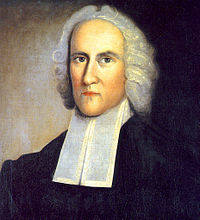
Jonathan Edwards (October 5, 1703 – March 22, 1758) was born on October 5, 1703, to Timothy Edwards and Esther Stoddard. He was the only son, born fifth of eleven children. He had a great education as a child, and entered collage at the age of Thirteen. As Jonathan Edwards became an older, wiser man, he began to take up different fields of work, such as colonial American preacher, theologian, and missionary to the Native Americans. He was known to be America's most important and original philosophical theologian. His works are broad, but he is most associated with his defence of of Calvinist theology,and the Puritan heritage. His best known work is "Sinners in the Hands of an Angry God".


